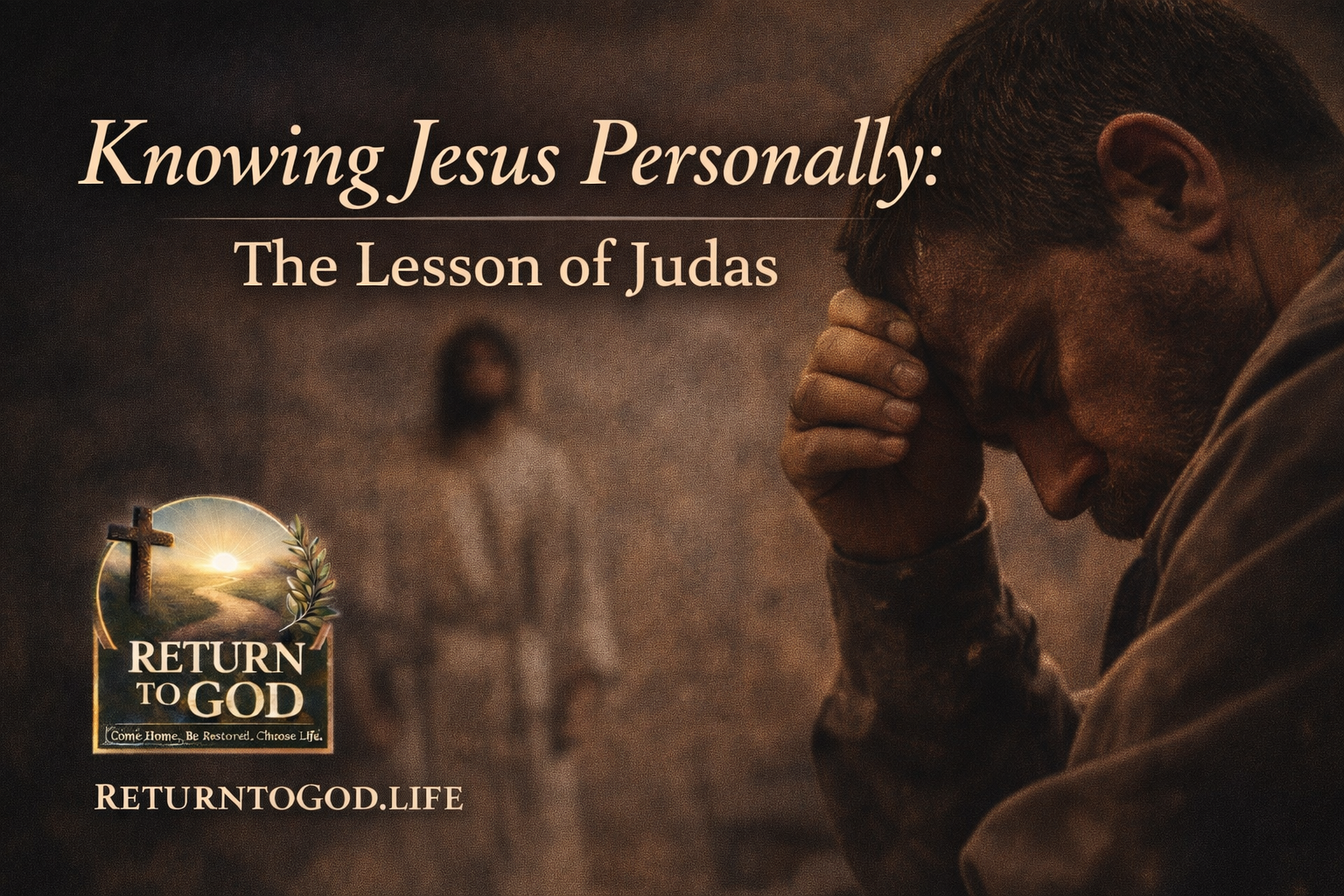
Knowing Jesus Personally
The Lesson of Judas
I was thinking today about Judas.
Judas walked with Jesus. He wasn’t on the outside. He wasn’t a distant observer. He was one of the twelve. He was sent out with the others. Scripture tells us that he preached, healed, and exercised authority just like the rest of them. He saw the miracles up close. He watched the sick healed. He saw the dead raised. He heard every teaching firsthand.
And yet, in the end, Judas betrayed Jesus. He failed in knowing Jesus.
That reality has always unsettled me, but lately it’s been pressing on me more deeply. How does someone see all of that and still miss who Jesus really is? To miss knowing Jesus. How does someone operate in power and still not truly know Him? That realization feels like part of the call to return to God, not just in belief, but in how we actually know Him.
It brings to mind one of the most sobering passages in Scripture.
“Many will say to me on that day, ‘Lord, Lord, did we not prophesy in your name, and in your name drive out demons and perform many miracles?’ Then I will tell them plainly, ‘I never knew you’” (Matthew 7:22–23).
That passage isn’t about atheists or outsiders. It’s about people who were active, effective, and visible. People who did real things in Jesus’ name. And yet Jesus says the issue wasn’t what they did. The issue was that He never knew them.
That’s where Judas comes into sharp focus for me.
Judas didn’t betray Jesus because he didn’t believe in Him at all. Judas betrayed Jesus because he believed in the wrong version of Him. He had expectations. He had an agenda. He wanted Jesus to act in a certain way and fulfill a certain role.
Judas wanted a Messiah who would overthrow Rome. A Messiah who would take power. A Messiah who would fix the political and social situation in front of him. And when Jesus continued to move toward surrender instead of dominance, Judas tried to force His hand.
Scripture tells us that Judas went to the authorities and handed Jesus over. But I don’t think Judas saw himself as the villain. I think he believed he was pushing Jesus toward the moment he thought was inevitable. Forcing Him to reveal His power. Forcing Him to act.
But Jesus never came to do what Judas wanted Him to do.
Jesus did not come to overthrow Rome. He came to overthrow sin. He did not come to establish an earthly kingdom through force. He came to establish a spiritual kingdom through sacrifice.
Judas couldn’t see that truth. And because he couldn’t see it, he couldn’t accept it.
That’s where the danger lies for all of us.
It is possible to work for Jesus without knowing Jesus personally. It is possible to serve, give, teach, and even see results while still missing His heart. Judas proves that proximity to truth is not the same thing as submission to it.
There’s a difference between seeking God for who He is and seeking Him for what He can do.
It’s the difference between wanting His face and wanting His hands.
Scripture talks about this kind of pursuit.
“Look to the Lord and his strength; seek his face always” (Psalm 105:4).
Seeking His face means wanting a relationship. It means wanting to know His heart, His will, His ways. Seeking His hands means focusing on outcomes. Provision. Power. Results. Victory. Relief.
Judas saw the hands of Jesus repeatedly. He saw power. He saw authority. He saw miracles. But he never truly sought the face of Jesus. He never surrendered his expectations long enough to receive who Jesus actually was.
And that’s the danger. We can seek what God gives without ever seeking God Himself.
Knowing Jesus personally means I’m willing to follow Him even when His hands don’t move the way I want them to. It means I stay when outcomes disappoint me. It means I trust His heart when I don’t understand His timing.
That kind of faith isn’t built through miracles alone. It’s built through a relationship.
Knowing Jesus personally means allowing Him to be who He says He is, not who we need Him to be to support our plans.
Judas followed Jesus as long as Jesus seemed useful to the story Judas had in his head. When that story fell apart, so did Judas. And instead of repenting and returning, he gave himself over to despair.
“The Son of Man will go just as it is written about him. But woe to that man who betrays the Son of Man” (Matthew 26:24).
Jesus wasn’t surprised by Judas. He wasn’t tricked. He knew Judas’ heart long before the betrayal. And yet Judas still walked with Him, still ate with Him, still participated in the ministry.
That’s a hard truth to sit with.
It tells me that miracles are not proof of intimacy. Results are not proof of a relationship. Nor is activity proof of knowing Jesus personally.
The real question is not, “What am I doing for Jesus?”
The real question is, “Do I know Him, and does He know me?”
Knowing Jesus personally requires surrender, not control. It requires accepting that He may not do what we expect or want. It requires trusting Him even when His path looks nothing like the one we had in mind.
Judas couldn’t do that. When Jesus refused to become the kind of savior Judas wanted, Judas rejected the kind of Savior Jesus actually was.
That’s a warning to me.
It’s possible to love the benefits of Jesus without loving Jesus Himself. It’s possible to want the outcomes He brings without wanting the way He walks. And when those two things collide, we have to choose.
Jesus said it plainly.
“If anyone would come after me, let him deny himself and take up his cross and follow me” (Matthew 16:24).
That’s not the path Judas wanted. And if I’m honest, it’s not always the path I want either.
Knowing Jesus personally means letting go of my expectations and receiving Him as He is. It means allowing Him to disappoint my plans while transforming my heart. It means choosing relationship over results, obedience over outcomes, and truth over control.
Judas shows us how close someone can be and still miss it. And that’s why his story matters. Not so we judge him, but so we examine ourselves.
Am I following Jesus for who He is, or for what I want Him to do?
Because in the end, knowing Jesus personally is not about what I’ve accomplished in His name. It’s about whether I’ve allowed Him to shape me, lead me, and be Lord instead of a tool for my agenda.
That’s the kind of discernment I need. And that’s the kind of return I want. It’s one of those slow steps on the road back.
This reflection is part of an ongoing journal where I’m learning what it actually means to follow Jesus and knowing Jesus personally, not just serving Him or hoping He serves me.
A Prayer for Knowing Jesus Personally, Not Just What He Can Do
Lord,
Your Word tells me to seek Your face, not just Your strength (Psalm 105:4). I confess that too often I’ve come to You wanting answers, outcomes, or relief instead of wanting You. I’ve wanted Your hands at work more than I’ve wanted Your presence in my life.
I don’t want to follow You with expectations You never promised to fulfill. I don’t want to use You to support my plans instead of surrendering to Yours. Teach me what it means to know Jesus personally, not just serve Him from a distance.
Search my heart and show me where I’ve been holding on to my own agenda (Psalm 139:23–24). Help me to lay it down and follow You as You are, not as I wish You would be.
I want to seek Your face, Lord, even when Your hands are still. I want relationship more than results, truth more than control, and obedience more than outcomes. Help me to walk with You honestly and faithfully, all the way to the end.
Amen.