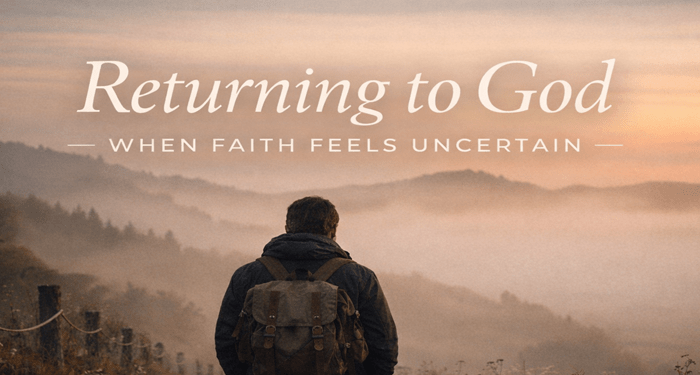
Returning to God When Faith Feels Uncertain
These days, when faith feels uncertain, returning to God feels like a stretching of my faith.
Not the kind of uncertainty that panics or spirals, but the quieter kind that removes the illusion of control. Returning to God lately has meant living with fewer answers than I would like and more dependence than I am comfortable with. It is a return that does not come with clarity up front, only the steady invitation to trust God where I cannot yet see the outcome.
Scripture has never promised certainty as a prerequisite for faith. In fact, it often presents uncertainty as the very place where trust is formed.
“Trust in the Lord with all your heart, and do not lean on your own understanding” (Proverbs 3:5).
That verse sounds comforting until you realize what it actually requires. Not leaning on your own understanding means accepting that “your understanding” may be incomplete for a while. It means walking forward without the reassurance of explanations. It means allowing faith to exist without resolution.
That kind of “returning to God” feels like a stretching because it is.
There was a time when, for me, returning to God meant doing something decisive. Not an “act of faith” per se, but a performance-based faith. Making a change. Drawing a clear line. Fixing what was broken. Those moments still matter, but they are not the whole story. These days, returning to God looks more like staying present in questions I cannot rush past and choosing obedience when faith feels uncertain, without the relief of certainty.
This is one of those slow steps on the road back.
Scripture describes this posture plainly. “For we walk by faith, not by sight” (2 Corinthians 5:7). That is not poetic language meant to soften reality. It is a description of how life with God actually works. Faith often moves ahead of sight, not alongside it.
Uncertainty has a way of exposing what I trust. When plans are unclear, when faith is uncertain, and outcomes are unsettled, I notice how quickly I want to grasp for control or reassurance. Returning to God in those moments means resisting the urge to force clarity and instead choosing faithfulness where I am.
Jesus addressed this tendency directly when he said, “Do not be anxious about tomorrow, for tomorrow will be anxious for itself” (Matthew 6:34). He was not minimizing responsibility. He was redirecting attention. Faith is practiced in the present, not stockpiled for the future.
When faith feels uncertain, stretching that faith does not feel heroic. It feels ordinary and slightly uncomfortable. It looks like prayer that is shorter and more honest — “God, I have no earthly clue what I am doing or what I am supposed to do. Or even how to do it. Please help me.” — It looks like obedience without emotional confirmation. It looks like showing up again, even when yesterday’s confidence has worn thin.
Returning to God is rarely linear. There are days when faith feels steady and others when faith feels uncertain. Scripture does not frame this tension as failure, but as formation shaped over time.
“Blessed is the man who remains steadfast under trial,” James writes, “for when he has stood the test he will receive the crown of life” (James 1:12).
Remaining steadfast does not mean feeling strong. It means staying.
That, more than anything, is what returning to God looks like right now. Not certainty or resolution, but a willingness to trust God in the stretch and walk forward even when faith feels uncertain.
This is part of the road back. It’s not dramatic or fast. But it is faithful.